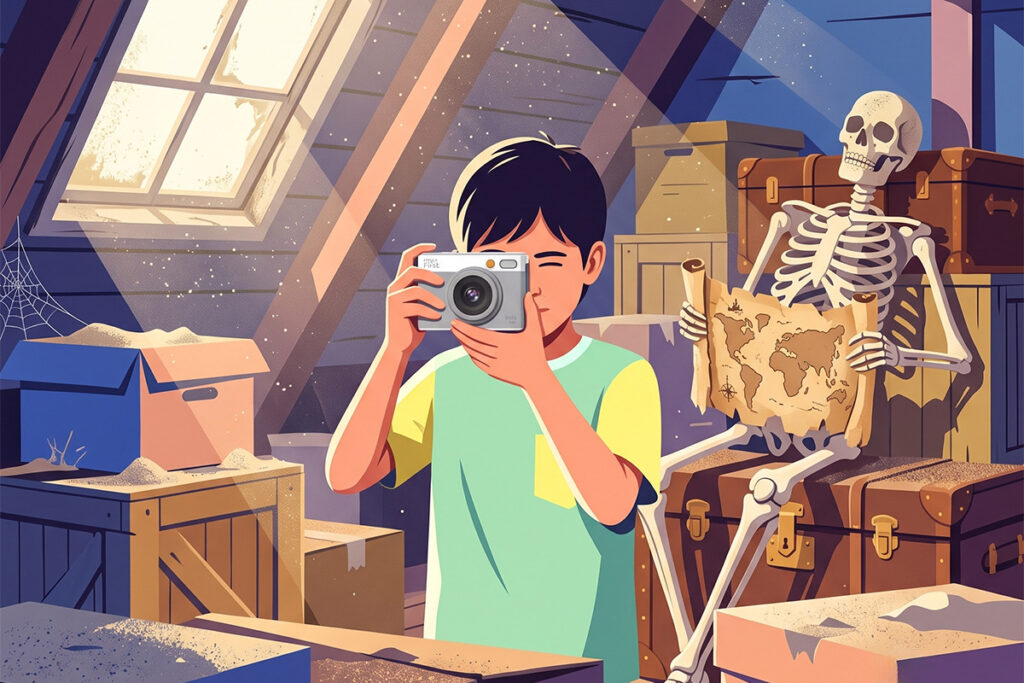
Digital cameras will always have a place in my heart — and my life, because my wife is a professional photographer. But lately, I’ve been seeing the perks of having an instant print camera in our lives, specifically the new myFirst Insta Lux.
Look, we live in an era of unprecedented documentation. If a tree falls in a forest and nobody captures a multi-angle 4K reel of it, did it even make a sound?
For parents and photography enthusiasts alike, the smartphone has turned us all into frantic archival hoarders. We compulsively hoard thousands of images, a lot of them identical in case one of them didn’t “come out right,” only to never do anything with them. Heck, I even feel like I’m diving into nostalgic strolls down memory lane less often than I used to.
But the reality of digital photography is much colder. Our screens have created a paradox: the more photos we take, the less we actually remember, and the less we value the moments we trap in digital purgatory. Plus, with essentially unlimited storage (especially in the cloud), we can just blast photos until we’re pretty sure one of them is good.
If you are looking to bring intentionality, tactile joy, and genuine memory retention back into your household and into your kids’ hands, it might be time to take a step back from pure pixels. Here is why an instant print camera isn’t a retro gimmick — it’s psychologically cool, too.
Digital Hoarding Isn’t… Good
When you have an infinite safety net of cloud storage, it’s so easy to just rely on it. Set it and forget it, you know? And boy do we forget it — the memory and details, that is. This behavior triggers a psychological phenomenon known as the “Photo-Taking Impairment Effect.”
A study by Dr. Linda Henkel at Fairfield University (Psychological Science) found that when people take photos of an object, they remember fewer details about it than those who simply observe it. By relying on a digital device to store the memory, our brains engage in cognitive offloading. I’m guilty of not knowing my own license plate, and have to look up pics of it each time I want to reserve parking at the airport.
Instant cameras flip this script. Because each print carries a physical cost, it forces the brain back into an active state of guided observation. Kids and parents stop snapping blindly and start analyzing light, composition, and meaning.
Your Cues Need Specificity
Scroll through your phone’s camera roll. It is a seamless, infinite stream of tiny, thumbnail-sized fragments. According to research, human brains do not retrieve autobiographical experiences through unstructured, abstract clouds of data. They require visually rich, unique, and highly specific cues.
A physical print exists in one place, with one physical texture, and a fixed composition. It has what researchers call concreteness. Basically, real-world objects stimulate deeper neural pathways than flat digital displays. When a child holds a physical photograph, the weight of the paper and the texture of the print become part of the memory encoding process itself.
Now, make them take pics of their clean rooms so they never forget how good it looks and feels.
Immediate Gratification Without the Digital Friction
We often think of digital cameras as providing instant gratification, but that’s kinda dumb. You take a photo, immediately look at the screen, swipe to see if it looks good, tweak a filter, and suddenly you are checking your notifications. The moment is gone.
True printed gratification is entirely different. Watching an instant photo develop right in front of your eyes bridges the gap between digital immediacy and physical reality. You don’t have to catalog a gallery, export files to a thumb drive, or brave the fluorescent lights of a pharmacy print lab weeks later. You don’t have to deal with adding ink to your printer, somehow, again, after you swear you just did it — or finding photo paper.
To me, that’s so worth it.
Get Out There And Be Creative, Dang It
Digital photos go to die in the cloud. They live behind glass, hidden inside deep, painfully designed UI that makes everyone so, so mad. Remember when Apple redesigned their photo app, and everyone hated it?
A physical print demands interaction. It forces families into the physical world of scrapbooking, pinning photos to refrigerators, or framing them for a bedroom wall. They cost money, so they’re inherently worth more, right?
When children see physical photos of themselves displayed around the house, it acts as a silent, daily reinforcement of belonging and self-esteem.
The Best of Both Worlds: The Insta Lux
I just spent the last few minutes telling you why an instant-print camera is great not just for kids but for everyone. But also, isn’t it nice to have a digital camera, too? One you don’t have to remember to load all the time? They say the best camera is the one you remember to bring.
The hardest pill to swallow about traditional instant cameras is the risk of a truly terrible shot. Blinking, missed focus, or a rogue thumb can ruin a costly piece of film.
This is where the Insta Lux stacks the odds in its favor. Designed as a hybrid ecosystem, it operates as a high-functioning digital camera first and foremost. You get the creative freedom to frame, snap, and experiment without anxiety. But instead of letting those files vanish into a server farm, the Insta Lux lets you selectively print your absolute favorite shots right from the device — or even reprint duplicates so everyone in the frame gets a copy to take home. Heck, you can even use it to print from your smartphone!
It strips away the cognitive offloading of endless digital snapping while retaining the safety net of modern tech. It doesn’t replace digital photography; it makes digital photography meaningful again.
So, you know, buy one now!