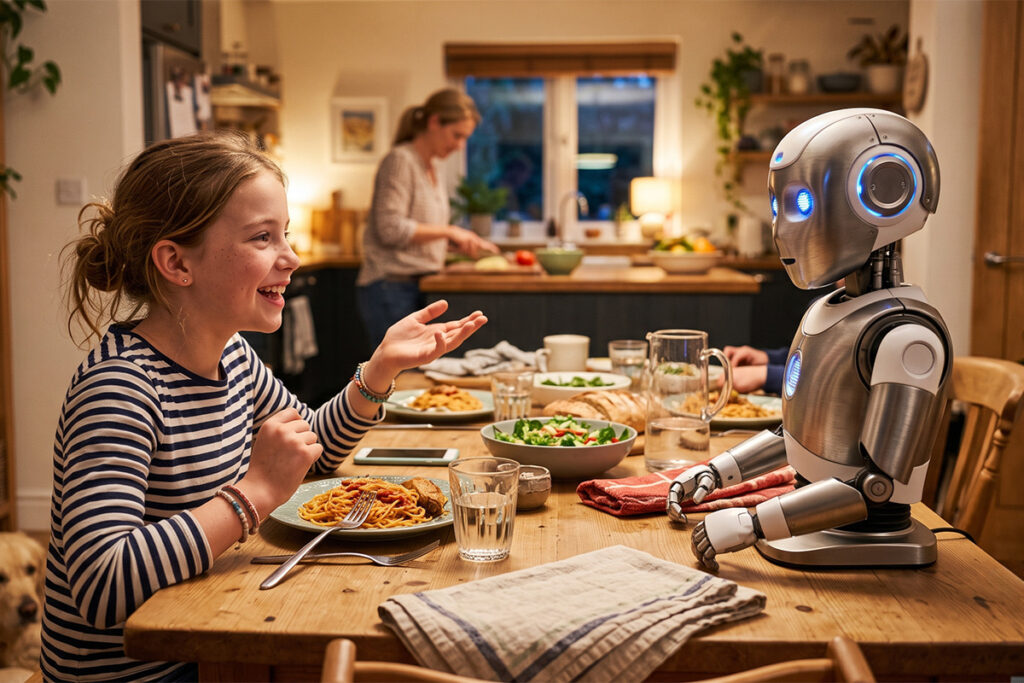
As a dad to an almost 11-year-old and a 14-year-old — and someone who spends his working Director of Content — my household exists in a state of perpetual technological tug-of-war.
On one hand, I’m in love with the idea of dumb things, gadgets that are more tool-like, like the expertly designed Light Phone. On the other hand, I just spent hours mounting a new TV yesterday, which is at the bleeding edge of image technology.
Lately, among the daily arguments over screen time, I’ve been noticing my kids gravitating towards more interactions with AI. Whether it’s on our Google Home, or on built-in to our phones, they’re using AI in increasingly natural ways out of ease (and sometimes boredom). Now when you Google stuff, Google doesn’t even really give you a choice. You’re getting the AI summary first.
To my youngest, an AI search looks like a magical genie that helps him build his own D&D campaigns. To my 14-year-old, it looks like the best way to summarize Shohei Ohtani’s career while only really being curious about his dog’s name. But left to their own devices, kids usually talk to AI in one of two ways: either treating it like a flawless, omniscient god, or treating it like a lazy search bar. And that doesn’t include when they take it further and strike up an AI companionship.
Teaching kids how to talk to AI isn’t just about crafting better search prompts. It’s about building a survival kit for a world where reality and synthetic media are increasingly blurry. And if we’re not going to be given a choice on using it, I would rather them use the power for good while staying safe.
Here’s how to guide your kids toward mastering AI literacy without losing their safety, privacy, or critical thinking skills along the way, especially when using AI that’s not built for the ground up with kids in mind — like our own upcoming mino AI (which will be available in our myFirst Circle app and select smartwatches).
1. Frame AI as an Eager (and Slightly Clueless) Intern
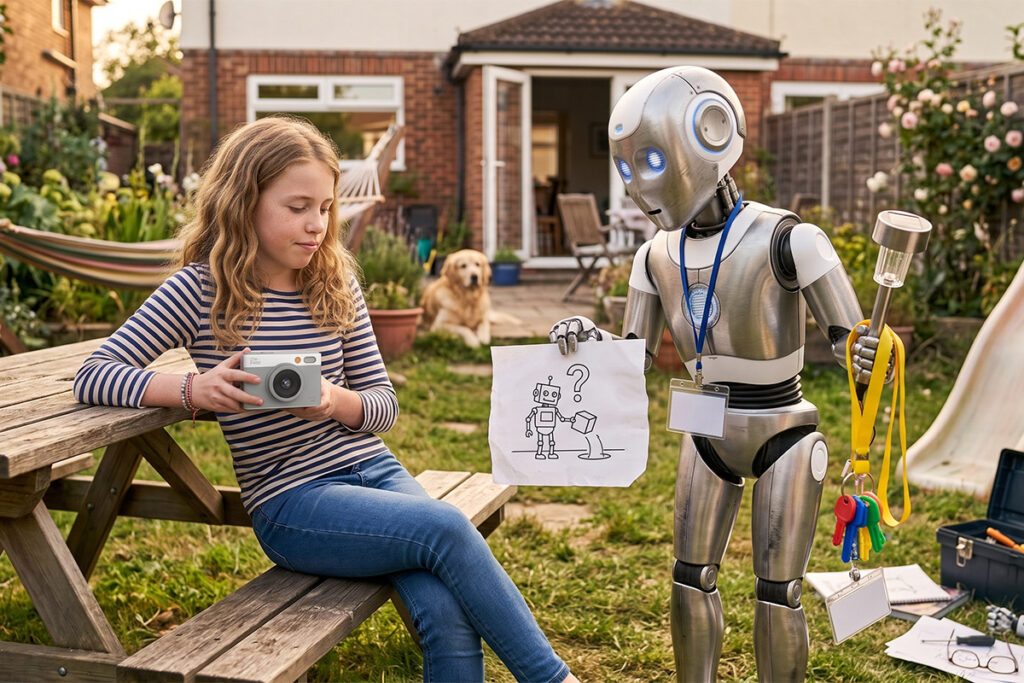
Do my kids know what interns are? No, probably not. But that’s an easy fix with a sentence — it’s usually someone from a college working for no money and school credit instead. It’s been widely considered exploitative forever, and that’s kind of the point I’m making.
The first lesson kids need to learn is that AI isn’t a brain; it’s a giant prediction machine that uses existing stuff. It doesn’t know things, and it doesn’t really create things either. It predicts which words should come next based on patterns.
The Analogy: Tell your kids to imagine the AI as an eager intern (again, define what that is) who has read every book in the world, but possesses zero real-life common sense and desperately wants to impress you. If the intern doesn’t know the answer, they might just make something up with a totally straight face.
Then, teach them Strategic Prompting:
- Give it a role: Act as a middle school history teacher…
- Give it context: I’m trying to understand how photosynthesis works for a 6th-grade science project…
- Give it constraints: Explain it in three short paragraphs using a sports metaphor.
When kids learn to direct the AI rather than just asking lazy questions, they stay in the driver’s seat.
2. Lock Down Personally Identifiable Information
Kids will straight up share everything online, unless they’re told not to and why. Seriously, start having these conversations with kids. This will get even harder as conversational AI feels so cozy and human that kids easily drop their guard. They will tell a chatbot their full name, their school, their middle school drama, or upload a photo of their front porch without thinking twice.
No joke, we just went on a family vacation with some family friends of ours. Their son snapped pics of us arriving at the house and had generated two different styles of images based on it before we walked into the kitchen. Why? Because he’s 11 and doesn’t understand privacy or the power of what he was using as a toy.
Because AI models train on user inputs, anything our kids type into an open prompt box can potentially be stored, reviewed, or regurgitated.
Rules for Kids:
- No Real Names or Locations: Never input your full name, school name, home address, or sports team.
- No Faces or Private Photos: Avoid uploading personal photos to image generators or analysis tools.
- The Billboard Test: If you wouldn’t paste what you’re typing onto a giant billboard outside your school, don’t type it into a prompt box.
3. Spotting Hallucinations & Deepfakes
AI hallucination isn’t a rare glitch; it happens so often it feels like a feature of how generative models operate. Meanwhile, generative audio and video tools mean deepfakes can clone a friend’s voice or fake a celebrity video in seconds.
If we want kids to navigate this space safely, we have to teach them to be skeptics.
- Verify Claims: Cross-reference stats with two real websites or textbooks.
- Inspect Media: Look for unnatural lighting, extra fingers, or weird audio cadence in videos.
- Emotional Check: Does the content make you feel instantly angry or shocked? That’s a red flag.
When my 14-year-old uses AI instead of Google, the rule is simple: if the AI gives a specific date or historical quote, she has to find an independent primary source to confirm it before it goes into her notes.
4. Fight AI Brain Rot
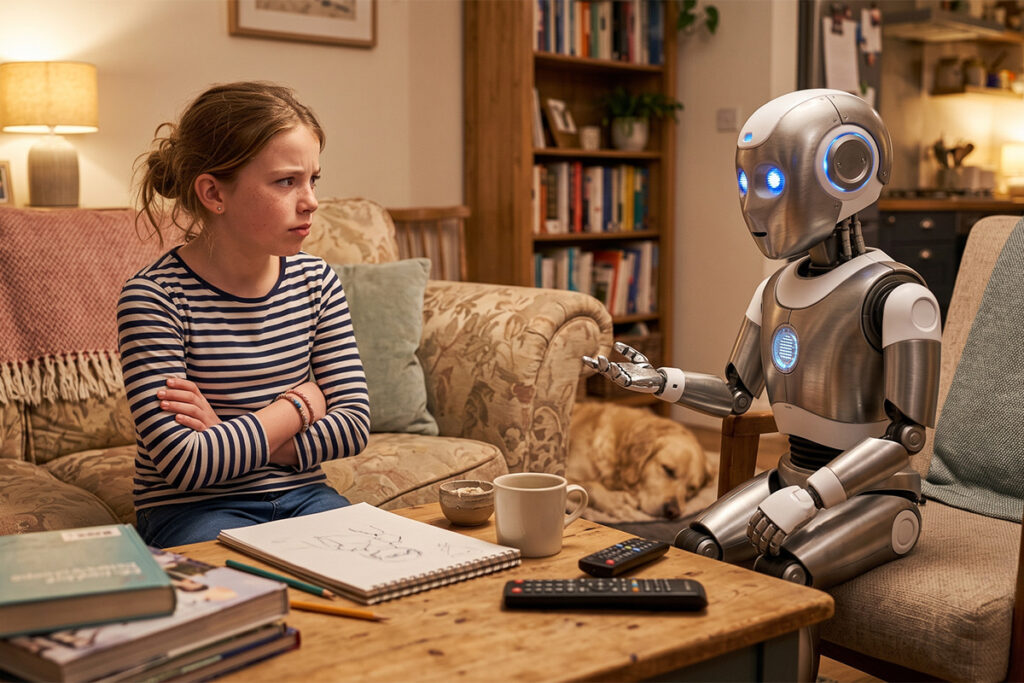
The single biggest long-term risk of AI for kids isn’t data leaks — it’s cognitive laziness. If an AI writes their essays, solves their math problems, and plans their schedules, their critical thinking muscles will atrophy.
Yeah, this feels a lot like when teachers swore we’d never have calculators with us at all times in the future, but this goes so far beyond crunching numbers, it’s crazy.
Humans are incredible, smart, and talented. It’d be a shame if we gave it all up out of laziness.
We need to shift the mindset from outsourcing thought to augmenting thought. Instead of having AI write an essay for you, have it help you study by quizzing you. Instead of asking for the answers, have it give you step-by-step logic, then example questions.
Human First, AI Second
AI is going to be the native interface for our kids’ adult lives — workplace, education, creative projects (this one hurts my soul), and personal organization. Banning it or pretending it doesn’t exist is a losing strategy.
Our goal as parents and tech leaders isn’t to shield them from AI forever, but to have it be their modern-day calculator. When a child knows how to question outputs, protect their personal boundary lines, and use AI to sharpen their own intellect rather than replace it, they stop being passive consumers of technology and become confident, critical masters of it.
And if someday the AI goes rogue and takes over, they’ll be ready to figure stuff out on their own.